When a Melody Stops Being an Exercise and Starts Being a Confession
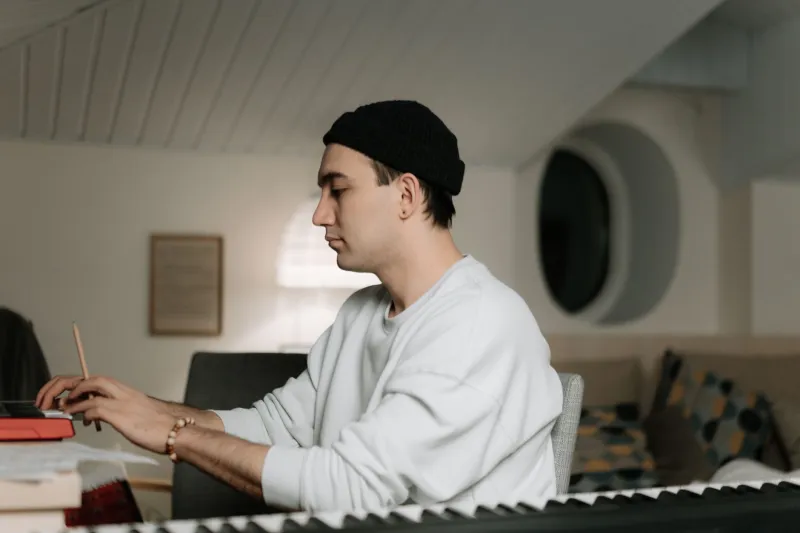
I've written songs I'm proud of that I would never, ever play for another human being. Not because they're bad — actually, some of them are pretty good, technically speaking. The chord progressions are interesting. The melodies move the way melodies are supposed to move. The lyrics rhyme in the right places without feeling forced.
But they're not mine. Not really.
And for a long time, I didn't fully understand the difference.
The Craft Problem
Here's the thing nobody tells you early on: you can get really good at writing songs that sound like songs. Like, you can study structure, learn what a pre-chorus is supposed to do emotionally, understand how a bridge should create contrast — and then execute all of that competently. Even beautifully, sometimes.
That's craft. And craft is genuinely valuable. I'm not dismissing it.
But craft alone produces songs that feel like they could belong to anyone. They're assembled correctly, the way furniture from a flat-pack box is assembled correctly. Functional. Presentable. Completely devoid of the fingerprints of whoever put it together.
I spent a good chunk of my earlier writing years in that zone — building songs that were technically solid and emotionally... safe. Songs that gestured toward feelings without actually touching them. Songs about heartbreak that described heartbreak from a respectful distance, like a nature documentary narrator who has never personally been heartbroken.
People would hear them and say nice things. And I would smile and say thank you and feel, underneath all of it, slightly hollow.
The Moment the Ground Shifts
I can tell you almost exactly when I first felt the difference.
I was writing late — which is when I do most of my real work, honestly — and I was trying to finish a song I'd started weeks earlier. It wasn't going anywhere. I kept circling the same melodic idea, trying different words on top of it, and nothing was landing. So I did what I sometimes do when I'm stuck: I stopped trying to write the song I thought I was writing and just started talking to myself through the chord progression.
And what came out was something I hadn't planned to say. Something specific and embarrassing and true about a period in my life I'd been carefully not examining. The kind of thing you might tell a therapist on a really honest day, not the kind of thing you expect to hear yourself singing in your kitchen at midnight.
The song that came out of that session scared me a little. It still does.
But it was the first time I finished a song and thought: that's actually mine.
Authenticity Isn't the Same as Oversharing
I want to be careful here, because I think there's a misconception that authentic songwriting means confessional songwriting — that to write something real, you have to expose everything, name names, air every piece of private grief in public.
That's not what I'm talking about.
Authenticity in a song isn't about the quantity of personal detail. It's about whether the emotional core of the thing is true. You can write in metaphor, in abstraction, in characters that aren't you — and still be completely, uncomfortably honest. Some of the most personal songs I've written don't mention a single specific fact about my life. But they came from somewhere real, and people who've been in similar places seem to feel that.
The difference is in the writing. When you're writing from that true place, there's a kind of friction to it. It's slower. It resists you. You'll write a line and then sit with it for a long time, not because you're not sure if it scans right, but because you're not sure if you're actually ready to say it.
That resistance is, I've come to believe, a pretty reliable signal that you're close to something worth saying.
The Songs That Don't Need an Audience
Here's the part that took me the longest to make peace with: not every authentic song needs to be released.
This feels counterintuitive in a moment when the whole industry logic is about output — more content, more drops, more presence on the algorithm. The idea of writing something real and then just... keeping it feels almost wasteful from a career standpoint.
But some songs are written for you. Some of them are how you process something before you're ready to share it. Some of them are a conversation you needed to have with yourself, and releasing them publicly would actually change what they are — would turn a private reckoning into a performance of a private reckoning, which is a completely different thing.
I have a folder on my laptop that I think of as the unreleasable songs. Not because they're bad. Because they're too specifically mine in a way that hasn't yet become universal. Maybe someday some of them will get there. Maybe they won't. But having them exist — having written them honestly — matters independent of whether anyone ever hears them.
That realization genuinely changed how I approach writing. Knowing that a song doesn't have to earn its existence by being performed took a lot of pressure off the process. It made it easier to go to the scary places, because the stakes felt different.
How You Start to Tell the Difference
If you're a songwriter reading this and trying to figure out where your own work falls on this spectrum, here are a few things I've noticed in my own process:
Technically solid songs tend to come easier. They flow. You're problem-solving more than excavating. When you finish them, you feel accomplished.
Songs that are actually yours tend to leave you feeling exposed even in a room by yourself. They often surprise you — the line that ends up being the most important one is rarely the line you sat down planning to write. When you finish them, the feeling is less like accomplishment and more like relief, or sometimes a low-grade anxiety that you said too much.
Neither type is more valuable in the abstract. But only one of them is irreplaceable. Anyone with enough skill can write a technically proficient song. Only you can write the one that came from your specific, weird, complicated interior life.
The Ongoing Negotiation
I don't think this is something you solve once and then have figured out. It's more like a muscle you keep training — the ability to notice when you're writing from the surface versus when you've actually gone somewhere.
And honestly, sometimes you need the surface songs. Sometimes you're tired and you just want to write something clean and structured and not emotionally demanding. That's fine. Not every session has to be a breakthrough.
But when you feel that shift — when a melody stops being an exercise and starts pulling at something you weren't planning to talk about — the best thing I've learned to do is stay in the room with it. Don't smooth it over. Don't make it more comfortable. Just follow it and see where it goes.
The songs that have meant the most to me, and apparently to the people who listen to them, were all written in that slightly uncomfortable space.
That's where the real ones live.