What I Heard When I Finally Stopped Talking Between Songs
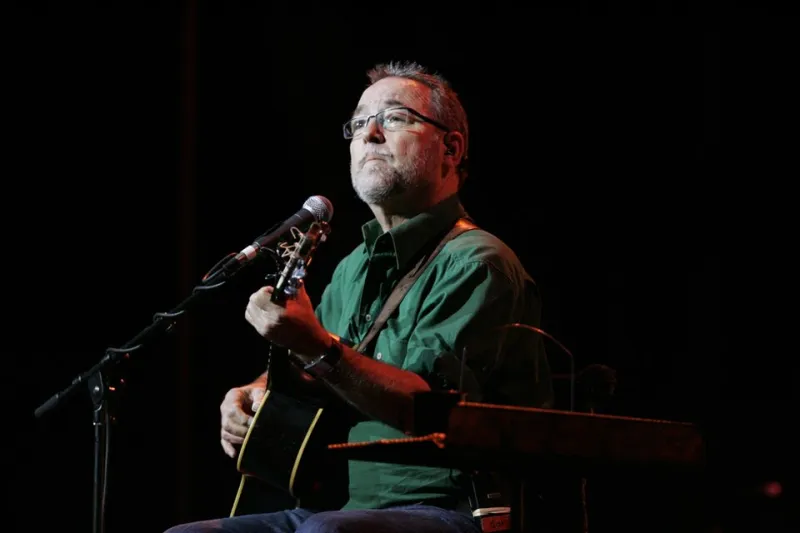
Photo: Eva Rinaldi, CC BY-SA 2.0, via Wikimedia Commons
There's this thing that happens when you're new to performing live. You finish a song, the last chord fades, and suddenly the room feels like a held breath. And your instinct — at least mine — is to fill it. Fast. With a joke, a story, a tuning ramble, a "so yeah, anyway..." that trails off into nothing useful. You talk because the quiet feels like failure.
I did this for years. I became genuinely good at it, honestly. I had little anecdotes ready. Crowd-warmers. Self-deprecating bits about forgetting lyrics. I could bridge from one song to the next so smoothly you might not even notice we were coasting through something that had no real purpose. It looked like stage presence. It felt like survival.
It took one very uncomfortable show in a small venue in Nashville to break me of it.
The Night the Room Went Still
The set had been going fine — not electric, but fine. I was halfway through a slower song, one of those that tends to land heavy when people are actually listening. I finished the last verse, held the final note a beat longer than usual, and then just... stopped. My hands left the strings. I looked up.
I don't know why I didn't immediately launch into my usual patter. Maybe I was tired. Maybe something about the way those twenty or thirty people were sitting made me pause. But the silence stretched out, five seconds, ten, and nobody moved. Nobody coughed. Nobody checked their phone.
And I realized: they were still in it. The song wasn't over for them yet. I had finished playing, but the music was still doing something in that room. And every single time I'd rushed past that moment before, I'd been cutting it off at the knees.
I let it sit. Probably fifteen seconds, which feels like a geological age on stage. Then I started the next song without saying a word.
Afterward, two different people came up to me and said some version of the same thing: that moment in the middle — that pause — that's when I actually started crying. Neither of them was talking about a lyric. They were talking about the nothing.
Why We're Scared of Empty Space
I think a lot of performers — especially singer-songwriters who are also the whole band, the whole show — operate from this low-grade anxiety that the audience is always one boring second away from leaving. So we keep moving. We keep producing. We confuse output with connection.
But that's not really how humans work, is it? Think about the best conversations you've ever had. The ones where you actually felt understood. Those conversations had pauses in them. Space where both people were just sitting with something that was said. The pause wasn't awkward — it was the point.
Stages are the same way, I think. The silence after a song isn't dead air. It's the audience doing their part. It's them processing, feeling, arriving somewhere. When I jump in immediately with a funny story about my cat or a shout-out to whoever booked the venue, I'm essentially interrupting that process. I'm saying my discomfort matters more than your experience.
That's not a great trade.
Learning to Sit in It
Changing this habit wasn't as simple as just deciding to be quiet. The anxiety is real. The silence feels enormous when you're the only one on stage and a hundred eyes are pointed at you. There were nights I lasted about three seconds before my mouth started moving on its own.
What helped me was reframing what the silence was. Instead of thinking of it as a void I needed to fill, I started thinking of it as part of the performance. The last note of a song isn't the end — the room settling after that note is the end. I started treating that as intentional. As something I was doing, not something that was happening to me.
I also started paying attention to what I actually wanted to say between songs versus what I was saying out of reflex. Turns out, a lot of my between-song chatter was filler with good delivery. When I stripped that away, the things I did say started to mean more. A single sentence about why I wrote something hits completely differently when it's not buried under three minutes of nervous energy.
What You Don't Play Is Part of the Song
This whole thing connected to something I'd understood intellectually about music but hadn't fully applied to performing: rests are notation. Silence is written into the score. In music theory class, you learn that rhythm only exists because of the space between beats. Without the gaps, there's no pulse — just noise.
The same logic applies to a live set. The transitions, the pauses, the moments where I just stand there and let the room catch up — those are structural. They're not interruptions in the performance. They are the performance, at least partly.
Some of my favorite live recordings, when I go back and listen, are the ones where you can hear the audience in those spaces. A quiet exhale. Someone shifting in their seat. The ambient sound of a room full of people who have gone genuinely still. That's not nothing. That's everything.
The Vulnerability Nobody Talks About
Here's the part that took me longest to admit: the reason I filled the silence wasn't just anxiety. It was control. When I'm talking, I know what's happening. I'm driving. The second I stop and let a room sit in quiet, I've handed something over. I don't know what they're feeling. I don't know if it's landing. I've made myself vulnerable in a way that a good joke or a clever segue would protect me from.
And that vulnerability — that exact feeling of not knowing — is probably the most honest thing I can offer someone who came out on a Tuesday night to hear me play.
The silence says: I trust you with this. I trust that you felt something. I'm not going to rush past it.
That's the kind of performer I want to be. Not the one who fills every corner of the room with sound, but the one who knows when to stop — and means it.